

Renovating a Property in Portugal: Permits, Costs and Choosing a Builder (2026)
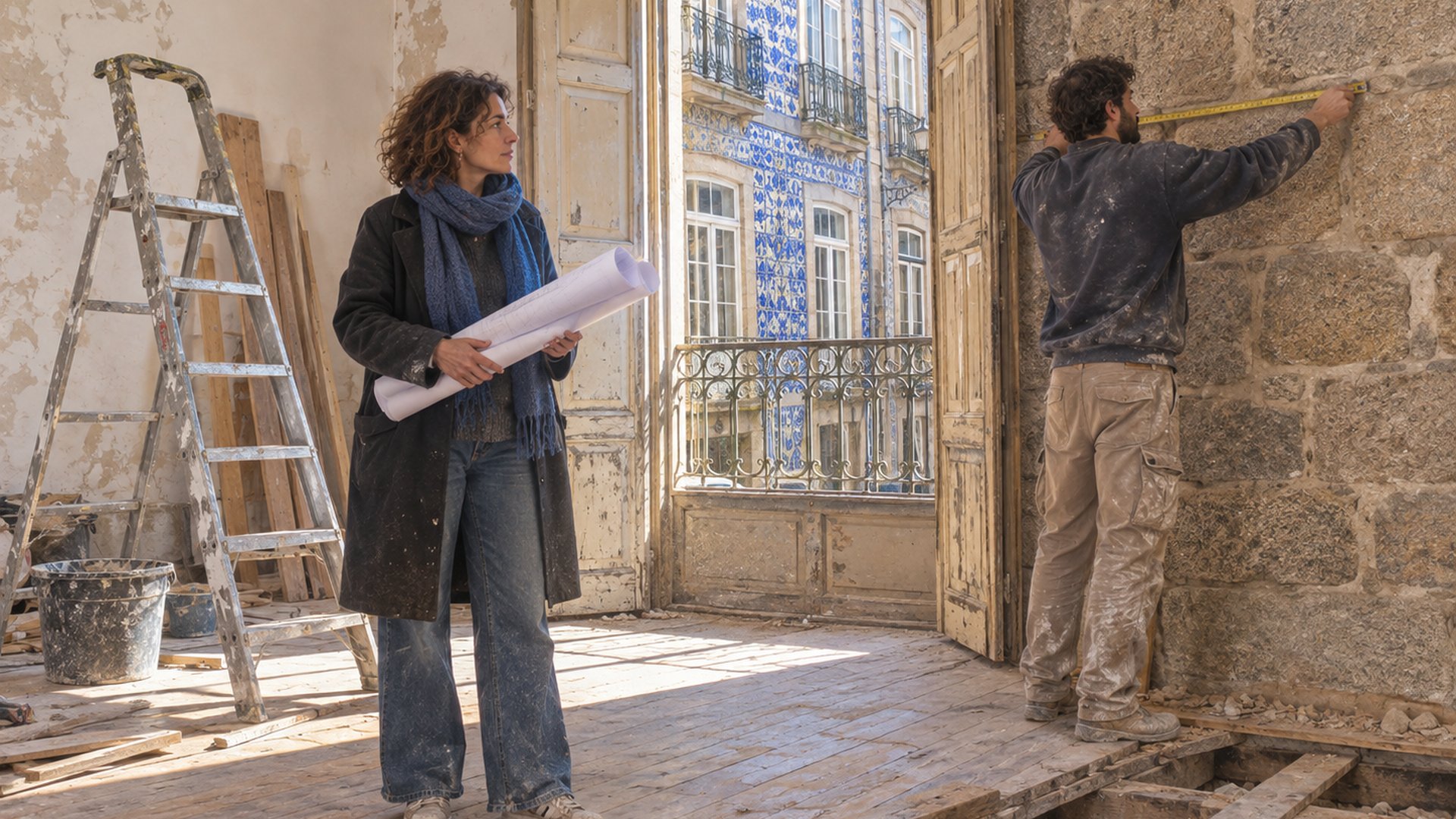
You found it: a tiled townhouse in Porto with high ceilings, a stone farmhouse in the Alentejo, or a 1960s flat in Lisbon with a river view and a kitchen that has not changed in forty years. The price looks right because the property needs work. Now the real questions start. Do you need a permit? How much will it cost per square metre? How do you choose a builder you can trust, especially if you live in another country?
This guide is for international buyers of any nationality who want to renovate a home in Portugal in 2026. It follows our article on living in Portugal in 2026 and walks you through licences, budgets, tax breaks, contractors and how to follow works from abroad.
Portugal's Renovation Rules Changed in October 2026
Portugal's building and planning law, the RJUE, was rewritten twice in three years. The 2024 "Simplex Urbanístico" reform widened the list of works that need no permit. Then Decree-Law 108/2026 fine-tuned those rules and came into force on 1 October 2026, after a delay set by Decree-Law 155-B/2026, as summarised by Apto Group and the law firm Cuatrecasas.
The good news for most buyers: a typical interior renovation is still simpler than in many European countries. The important change: some extensions and rebuilds that were exempt in 2024–2026 now need a permit or prior notice again, and fines for works without the right title have been restored.
Do You Need a Permit? The Three Routes
Every project in Portugal falls into one of three categories. Knowing which one applies to you is the first step of any budget and timeline.
1. Exempt works (no permit, but usually a notice)
According to Apto Group's analysis of the 2026 RJUE, you do not need a licence or prior notice for:
- Maintenance: repairs, restoration, painting and replacing like for like.
- Interior alterations that do not change the outside of the building: a new kitchen or bathroom, new floors, new plumbing and wiring, removing a non-load-bearing partition.
- Works of minor urban relevance, such as a small outbuilding of up to 10 m² and 2.2 m high, set back from the public road.
- Faithful reconstruction that restores the building to its last legal state, without adding floor area or volume.
Two details matter. First, you must still notify the câmara municipal (town hall) at least five days before work starts and post a notice on site, unless the job is pure maintenance carried out entirely indoors. Second, if you touch the structure, for example by opening a load-bearing wall, the work is only exempt with a structural design and a statement of responsibility signed by a qualified engineer.
2. Prior notice (comunicação prévia)
Where the planning parameters for the area are already defined, many alterations and extensions go through a prior notice. Your architect files the project, you pay the fees and give notice that work is starting, and you can begin without waiting for a formal approval. The council checks the file afterwards.
3. Full building licence (licença)
A licence is needed for works outside those cases: many extensions, works on listed buildings or in their protection zones, and areas with special restrictions. Under the 2026 rules, deadlines run stage by stage: about 20 days for the completeness check, 30 days for the architecture and 20 days for the final decision, with tacit approval at each stage if the council does not reply in time (Apto Group).
Common traps
- Façade tiles: removing azulejos from a façade always requires a licence.
- Anything visible from outside, such as new windows, a new roof shape or an enclosed balcony, ends the exemption.
- Apartments: works that change the look of the building need the approval of two-thirds of the condominium, measured by the building's total value.
- Fines: works that needed a title but went ahead without one can be fined from €500 to €200,000 for individuals, and the council can stop the works.
How Much Does Renovation Cost in Portugal in 2026?
There is no official price per square metre, so use market ranges to plan and then get itemised quotes. Labour is the fastest-rising cost: it accounts for 40–50% of a typical project according to Remodel.pt.
| Type of work | Indicative cost 2026 | What it usually includes |
|---|---|---|
| Light renovation | €150–400/m² | Painting, new floors, sanitaryware, partial rewiring |
| Medium renovation | €400–700/m² | New kitchen and bathroom without changing the layout |
| Full renovation | €700–1,500/m² | All pipes and cables, floors, windows, often a new layout |
| New bathroom (4–6 m²) | €4,500–9,000 | Complete bathroom, fittings and tiling |
Ranges from Pearls of Portugal. Location changes the price a lot. For a full mid-range renovation, Remodel.pt indicates about €1,050/m² in central Lisbon, €1,000/m² in Cascais, €950/m² on the Algarve coast, €880/m² in Porto and €800/m² in inland towns such as Coimbra or Leiria.
A worked example: a 90 m² two-bedroom flat in Porto with a full mid-range renovation would cost roughly €79,000 in works alone. Then add:
- Architect and engineering, if you change the layout or touch the structure.
- Municipal fees for the notice or licence.
- Furniture and appliances, often outside the building contract.
- A contingency of 10–20%, closer to 20% for houses older than 50 years.
Tax Breaks That Can Lower the Bill
6% VAT instead of 23%
Two rules can reduce VAT on works from 23% to 6% in mainland Portugal (4% in the Azores and Madeira):
- Urban Rehabilitation Areas (ARU): rehabilitation contracts on buildings inside a legally delimited ARU qualify for 6% VAT. Law 48/2026 confirmed that the ARU designation is enough, without a separate rehabilitation operation (PLMJ). Many historic centres, including large parts of Lisbon and Porto, are ARUs.
- Housing construction and renovation: under Decree-Law 97/2026, works on homes for the owner's permanent residence with a value of up to €660,982, or for residential letting with rent up to €2,300 a month, can also qualify, for procedures started between 25 September 2025 and 31 December 2029 (Belim; Deloitte tax@hand).
One practical warning: the reduced rate applies to the works contract (empreitada) with your builder. Materials you buy yourself, design fees and site supervision are normally taxed at 23%, as the Portuguese accountants' association OCC explains. Ask your town hall for the document confirming the ARU before signing.
IMI and IMT exemptions for rehabilitated buildings
Article 45 of the Tax Benefits Statute covers buildings completed more than 30 years ago or located in an ARU. If the works raise the building's conservation level by two grades, to at least "good", and meet energy-efficiency rules, owners can obtain, according to the government's Portal da Habitação:
- No IMI (annual property tax) for three years from the end of the works, renewable for five more for a permanent home or long-term rental, if the municipality approves.
- A refund of IMT (purchase tax) if you start the works within three years of buying.
- No IMT on the first sale after the works, in specific cases.
You must request recognition together with your prior notice or licence application, so plan this with your architect from day one.
How to Choose a Builder in Portugal
This is where most problems start, and also where they can be avoided.
- Check the IMPIC licence. Construction companies need an alvará or certificate from IMPIC, the national construction regulator. Search the company's tax number on the IMPIC public register and confirm the licence is active, covers private works and that its class matches the value of your project. Also check the list of licences cancelled in the past year, as suggested by CertiAmb.
- Compare at least three itemised quotes based on the same written scope and the same list of materials.
- Sign a written works contract with the price, timeline, payment milestones, penalties for delays and a warranty.
- Pay by milestones, never most of the price up front, and keep 5–10% until final acceptance.
- Ask for insurance: workplace accident and public liability policies.
- Speak to two previous clients and, if possible, visit a finished project.
Timelines: What to Expect
- Light or medium interior renovation (exempt): five days' notice, then usually two to four months of works for a flat.
- Prior notice: add the time for the architect's project and the filing, often a few weeks.
- Licence: plan several months for design and approval before works begin, then six to twelve months on site for a full house renovation.
Builders' calendars are often full, so book early. Summer and the end of the year are the busiest periods.
Following the Works from Abroad
Many of our clients renovate while still living in another country. It works well with the right structure:
- Appoint someone independent on the ground: an architect, engineer or project manager who checks quality, measures progress and approves each payment.
- Agree a reporting routine: weekly photos and videos, a short written update and a monthly video call.
- Use a written change log: every extra or change is priced and approved in writing before it is done.
- Keep your paperwork tidy: your Portuguese tax number (NIF), the contract, the notice or licence and all invoices with your NIF. You will need them for tax breaks and for a future sale.
Buying to Renovate: Check Before You Sign
The best renovation decisions are made before the purchase. Ask a lawyer and a technician to check the land registry and the usage licence, confirm whether the property is in an ARU or a protected zone, assess the structure and roof, and get a rough renovation estimate before you sign the promissory contract. Since October 2026, the deed must state whether the planning titles exist, which is an extra protection for buyers. Our step-by-step guide to buying a home in Spain as a non-resident follows the same logic, and our article on renting a home abroad helps if you need a base while the works are under way.
Renovate in Portugal with Hexedes
Hexedes Group has 15 years of experience and more than 1,500 relocation and property projects behind it. With our local advisors and trusted technicians in Portugal, we help you check a property before buying, define the scope and budget, select licensed builders and follow the works for you until the keys are in your hand. Book a free introductory call and tell us about your project.
This article is for information only and is not legal or tax advice. Rules and prices change: always check your own situation with a qualified professional.






Book your introductory video call
Click the button below and fill out the form to book your call
Book nowYour project starts here
Whether you want to live elsewhere or invest across the globe, hexedes offers you a single point of reference: professional, human and present everywhere. We listen to you, analyse your goal and build the right strategy for you.